



Copper Oxide vs. Phosphorized Copper Balls for PCB Plating: Key Differences and Applications
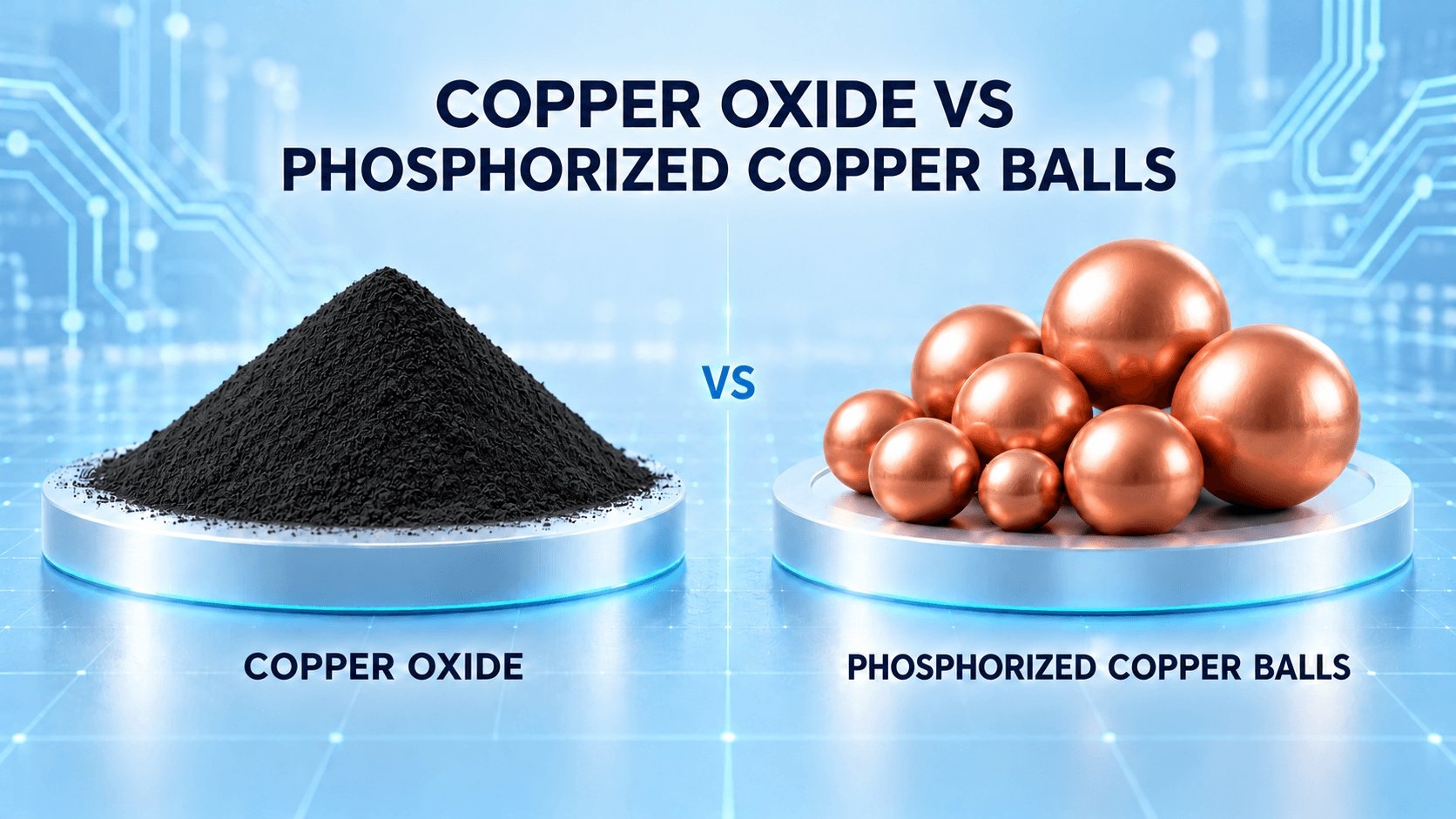
Copper oxide (CuO) and phosphorized copper balls are both used to supply copper ions in printed circuit board (PCB) electroplating, but they work through different replenishment methods.
Phosphorized copper balls serve as soluble anodes, releasing copper ions directly into the plating solution as they dissolve. Copper oxide, on the other hand, is commonly used as an external copper source in systems equipped with insoluble anodes, allowing copper replenishment to be controlled separately from the anode reaction.
These differences affect copper-ion control, anode maintenance, equipment requirements and plating operations. For PCB manufacturers using or evaluating insoluble-anode systems, copper oxide offers a practical method of copper replenishment, provided its purity, dissolution behavior and consistency meet the process requirements.
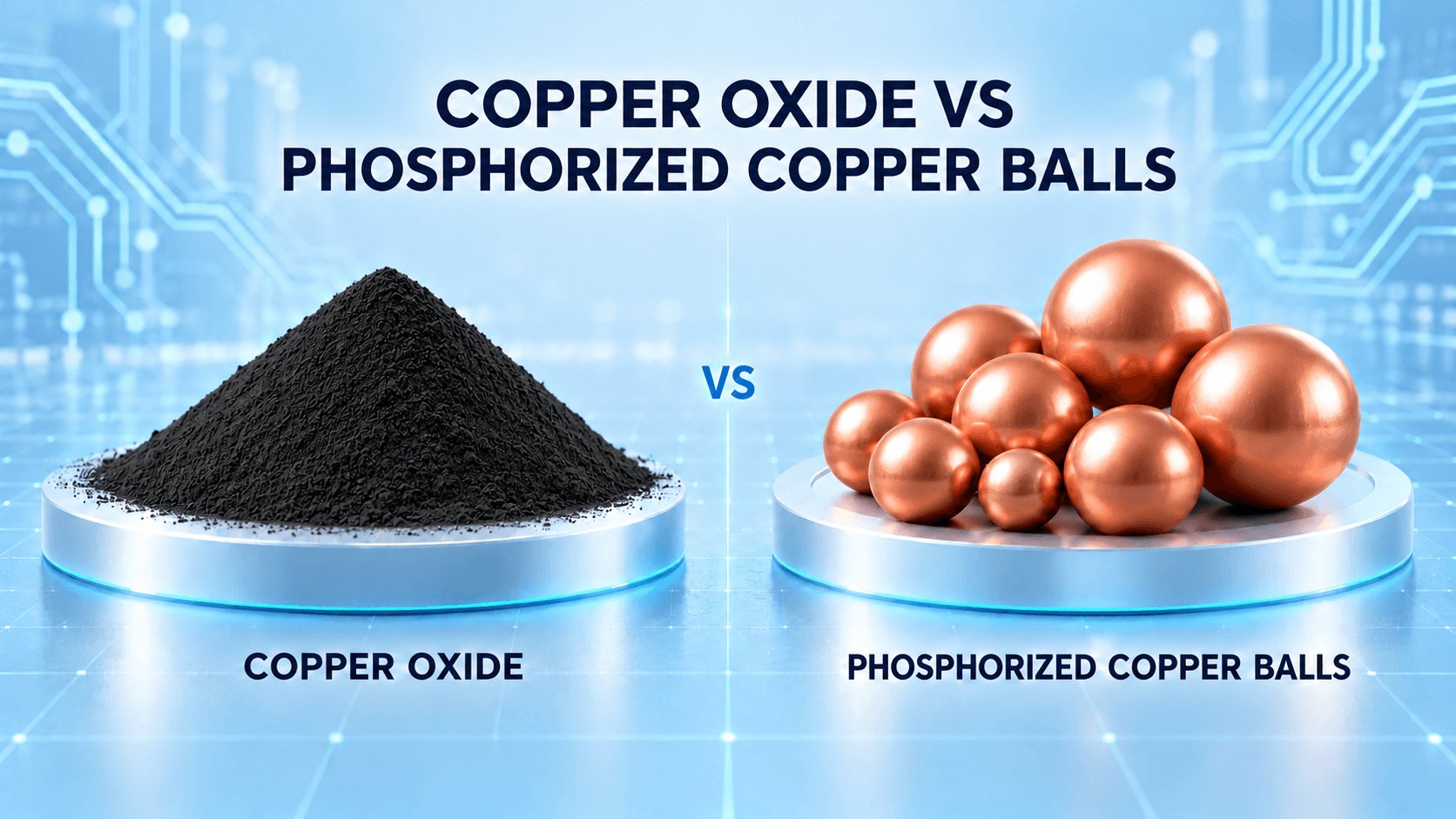
[AI generated] Copper Oxide and Phosphorized Copper Balls
How Copper Oxide and Phosphorized Copper Balls Work
Phosphorized Copper Balls in Soluble-Anode Systems
Phosphorized copper balls are widely used in acid copper electroplating. They are typically placed in titanium baskets and function as soluble anodes.
During plating, copper dissolves from the anode and releases copper ions into the electrolyte:
Cu → Cu²⁺ + 2e⁻
This replenishes copper as it is deposited onto the PCB, without requiring a separate copper oxide dissolution system.
Phosphorized copper anodes form a characteristic surface film that helps regulate anodic dissolution. Maintaining suitable operating conditions, electrical contact and anode-film behavior is important for stable performance.
As the copper balls are consumed, their quantity and arrangement within the baskets change. Periodic replenishment and maintenance are required, while anode bags help prevent particulate matter from entering the plating solution.
Copper Oxide in Insoluble-Anode Systems
In an insoluble-anode system, the anodes conduct current without dissolving to replenish the copper deposited onto the PCB.
A separate copper source is therefore needed.
Copper oxide is commonly used for this purpose in acid copper sulfate plating systems. It reacts with sulfuric acid to produce copper sulfate and water:
CuO + H₂SO₄ → CuSO₄ + H₂O
CuO is typically dissolved in a dedicated replenishment unit before the copper-containing solution is introduced into the plating bath.
Copper replenishment can be managed through automated dosing based on ampere-hour consumption and bath analysis, helping maintain the required copper-ion concentration.
Because copper replenishment is separated from the anode function, the system can use insoluble anodes with relatively stable geometry throughout operation.
Key Differences Between Copper Oxide and Phosphorized Copper Balls
The following comparison focuses on two common PCB copper plating arrangements: CuO replenishment with insoluble anodes and phosphorized copper balls used as soluble anodes.
| Comparison | CuO with Insoluble Anodes | Phosphorized Copper Balls as Soluble Anodes |
| Copper source | CuO powder dissolved in an external replenishment system | Copper balls that dissolve during electroplating |
| Anode type | Typically coated titanium insoluble anodes | Phosphorized copper balls held in titanium baskets |
| Copper replenishment | Controlled through dissolution and dosing equipment | Copper ions released through anodic dissolution |
| Anode geometry | Remains relatively stable during operation | Changes as copper balls are consumed |
| Automation | Supports automated copper dosing and bath monitoring | Replenishment and monitoring can also be automated, depending on equipment |
| Maintenance | Requires management of dissolution equipment, filtration and anode condition | Requires copper-ball replenishment, anode-film control and basket maintenance |
| Process considerations | Copper dosing, acid balance, additive consumption and CuO quality | Anode dissolution, surface-film condition, particulates and electrical contact |
| Equipment requirements | Insoluble anodes and a suitable external copper replenishment system | Soluble-anode baskets and associated equipment |
Both arrangements are used in PCB manufacturing. Their suitability depends on the plating equipment, electrolyte chemistry, required deposit characteristics and production conditions.
Where Copper Oxide Offers Advantages in PCB Plating
Copper oxide is particularly useful in processes designed around insoluble anodes and separately controlled copper replenishment.
Three characteristics are important when evaluating its role in such systems.
1. Controlled Copper-Ion Replenishment
CuO can be dissolved and supplied through an automated replenishment system, allowing copper addition to be adjusted according to plating consumption and bath analysis.
This is useful in production lines where copper-ion concentration must remain within defined operating limits.
The dissolution characteristics of CuO also matter. A material that dissolves consistently under the intended operating conditions helps the replenishment equipment respond predictably to copper demand.
Particle characteristics, acid concentration, mixing conditions and material grade can all influence dissolution behavior.
2. Reduced Dependence on Soluble-Anode Maintenance
In a CuO-fed insoluble-anode system, copper replenishment no longer depends on the gradual consumption of phosphorized copper balls.
This removes the need to replenish soluble copper-anode baskets and avoids the particulate sludge associated with those anodes.
However, the benefit comes from the overall insoluble-anode arrangement rather than CuO alone.
The system still requires appropriate maintenance of its anodes, replenishment equipment, filtration and plating solution.
3. More Consistent Anode Geometry
Insoluble anodes retain their geometry more consistently because they are not consumed to supply copper ions.
When the electrodes and plating equipment are properly designed, stable anode geometry can help maintain consistent current-distribution conditions.
This is relevant to PCB processes where deposit-thickness distribution requires close control.
CuO supports this arrangement by supplying copper independently of the anodes.
For advanced HDI and blind-via filling, however, plating performance also depends on electrolyte chemistry, additives, current distribution and solution flow. The use of CuO does not independently guarantee uniform deposition or successful via filling.
What to Consider When Using CuO for Copper Replenishment
Copper oxide replenishment requires suitable equipment and process control. The following areas should be evaluated when implementing or operating a CuO-fed insoluble-anode system.
Copper Oxide Dissolution and Filtration
CuO is generally dissolved under controlled conditions before the replenishment solution enters the main plating bath.
A suitable dissolution system must account for powder feeding, acid conditions, mixing, dissolution time and filtration.
Undissolved particles should be managed to prevent them from entering the plating process.
The equipment configuration and operating conditions should follow the requirements of the specific plating system.
Copper-Ion Concentration and Acid Balance
Copper-ion consumption can be estimated from plating current and operating time, often expressed in ampere-hours (A·h).
Automated replenishment systems may use this information to determine copper dosing, together with analytical measurements of the plating solution.
Because CuO consumes sulfuric acid during dissolution, acid concentration must also be monitored as part of the overall bath balance.
Actual operating conditions, drag-out and other reactions can affect both copper-ion and acid concentrations.
Additive Management
Insoluble anodes introduce different electrochemical conditions from soluble copper anodes.
Depending on anode design and electrolyte chemistry, oxygen evolution and other anodic reactions may contribute to the breakdown of organic plating additives.
Anode protection, electrolyte formulation and additive monitoring are therefore important considerations.
These requirements should be evaluated with the plating chemistry and equipment suppliers rather than determined by the copper source alone.
Equipment Compatibility
An existing phosphorized copper-ball plating line cannot generally adopt CuO as a direct replacement without reviewing the anode and copper-replenishment arrangement.
Converting to an insoluble-anode system may require changes to electrode hardware, dissolution equipment, dosing, filtration and process monitoring.
The decision should be based on the existing equipment and production requirements, including maintenance, operating costs and the results of process validation.
How to Select Electroplating-Grade Copper Oxide
For a PCB plating process that uses CuO replenishment, material quality directly affects the reliability of copper addition.
Three factors are particularly important when comparing CuO grades and suppliers.
1. Copper Content and Impurity Control
Copper content and impurity levels should be evaluated against the requirements of the intended plating process.
Trace metals such as iron (Fe), nickel (Ni) and lead (Pb) may affect bath chemistry or deposit quality, depending on their concentration and the application.
Chloride (Cl⁻) is also important in acid copper sulfate plating because it is typically maintained within a controlled concentration range as part of the additive system.
Chloride introduced through replenishment materials must therefore be considered when managing the bath.
For supplier evaluation, buyers should request the actual impurity limits applicable to the product grade rather than relying only on a general high-purity description.
2. Dissolution Performance
CuO should demonstrate suitable dissolution performance under the operating conditions of the intended replenishment system.
Differences in particle characteristics, material processing and impurity levels can influence dissolution behavior.
Consistent dissolution helps support controlled copper addition and reduces the likelihood of undissolved material accumulating in the replenishment equipment.
When comparing products, dissolution results are most useful when the test conditions are clearly defined.
3. Batch Consistency and Quality Documentation
Batch consistency is important for production lines that depend on predictable copper replenishment.
A Certificate of Analysis (COA) provides a basis for reviewing material quality against agreed specifications. Relevant parameters may include copper assay, controlled impurities and other product-specific quality requirements.
Lot identification and traceability also help manufacturers investigate variations in raw-material performance.
For a more detailed discussion of material specifications, dissolution behavior and supplier evaluation, see Electronic Grade Copper Oxide for PCB Copper Plating: Process Fundamentals, Material Specifications, and Supplier Evaluation.
Frequently Asked Questions
Q: Can Copper Oxide Directly Replace Phosphorized Copper Balls?
A: Not as a direct substitution in a conventional soluble-anode arrangement.
Phosphorized copper balls function as electrodes, while CuO is used as a copper replenishment material.
A change to CuO-fed insoluble-anode plating generally requires a suitable anode configuration and an external copper replenishment system. The extent of modification depends on the existing equipment and process.
Q: Is Copper Oxide Only Used for Advanced HDI or Via-Filling Processes?
A: No. CuO can be used in different PCB copper plating applications where the process is designed for external copper replenishment.
Its use is associated with the selected plating system rather than a single PCB category.
Advanced HDI, fine-line plating and via-filling applications may benefit from appropriately designed insoluble-anode systems, but the required plating performance must be achieved through the complete process.
Q: Can Copper Oxide Made from Recycled Copper Be Used for PCB Plating?
A: Yes, provided the finished CuO meets the required electroplating-grade specifications.
The raw-material source does not replace the need to control purity, trace impurities, dissolution behavior and batch consistency.
Both primary and recycled copper sources can be considered when the resulting material has been appropriately processed and verified for the intended application.
Copper Oxide for Reliable PCB Copper Replenishment
Copper oxide and phosphorized copper balls provide copper to PCB plating solutions through different methods.
Phosphorized copper balls are used as soluble anodes, while CuO allows copper ions to be supplied separately in systems equipped with insoluble anodes.
For manufacturers using CuO replenishment, reliable operation depends on both the plating-system design and the quality of the copper oxide.
Consistent dissolution, controlled impurity levels and dependable batch quality are important when selecting a material for long-term production.
Pan-Continental Chemical supplies electroplating-grade Copper Oxide for PCB manufacturing. For product specifications or material inquiries, contact our team to discuss your application requirements.

