



Electronic Grade Copper Oxide for PCB Copper Plating: Process Fundamentals, Material Specifications, and Supplier Evaluation
Key Takeaways:
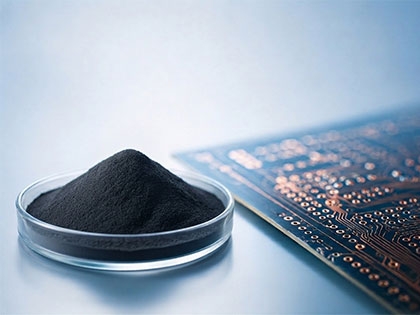
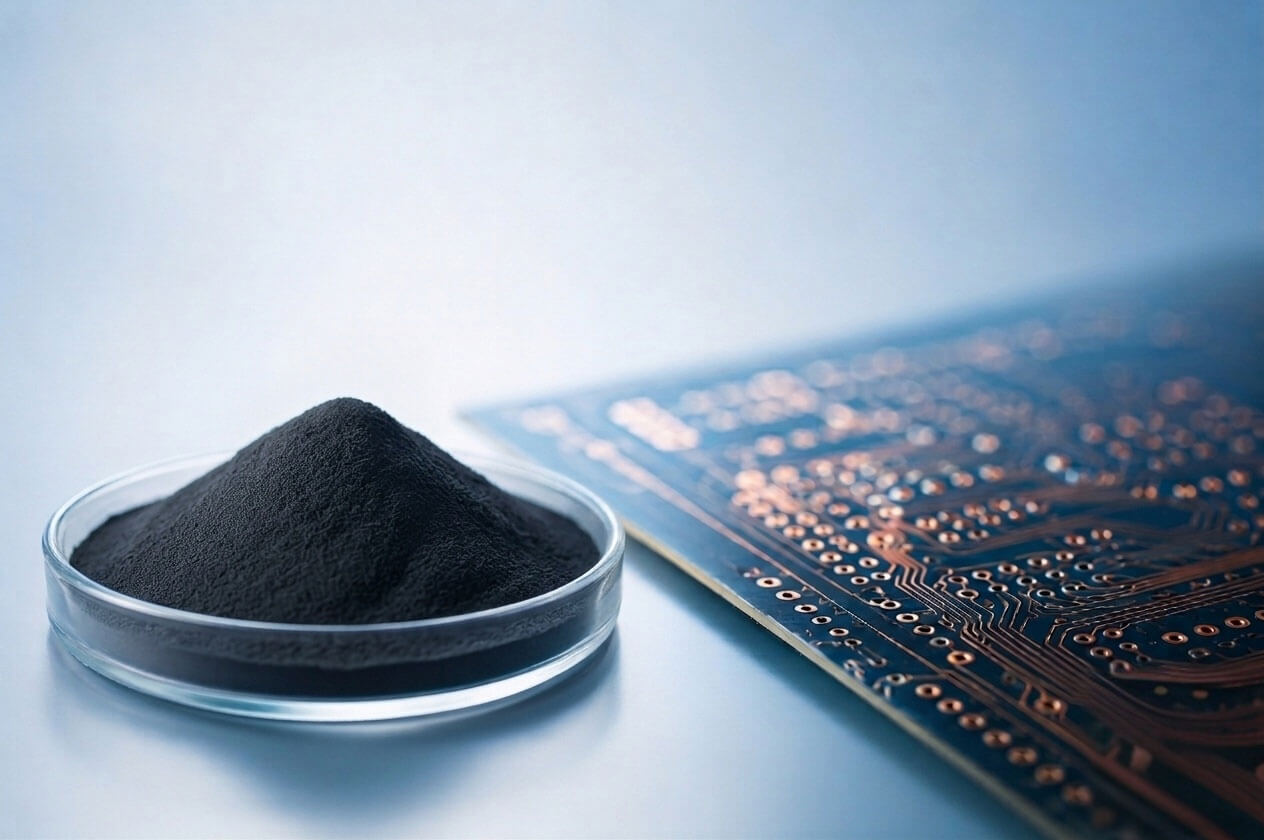
Electronic-grade copper oxide (CuO) is the core material for replenishing Cu²⁺ ions in the insoluble anode electroplating process used for PCBs. Compared to industrial-grade alternatives, it offers extremely low impurity levels (such as Cl⁻ and Fe) and a high dissolution rate. These properties ensure the stability of the plating solution during high-speed production of High-Density Interconnect (HDI) boards, effectively preventing particle nodules and defects.
In PCB copper plating, bath stability depends heavily on the purity and dissolution consistency of the Cu²⁺ replenishment source. This is especially important in insoluble anode systems, which are widely used for HDI and high-layer-count board production. The sections below explain how CuO functions in these processes, why raw material specifications directly affect bath stability, and what to evaluate when comparing suppliers.
Why Insoluble Anode Systems Require Copper Oxide Replenishment
Phosphorized copper anodes dissolve continuously during plating, which keeps Cu²⁺ concentration up but introduces a set of process variables that are difficult to control precisely. As the anode material is consumed, anode height drops, the anode-to-cathode area ratio shifts, and current distribution becomes less predictable. Replenishing the titanium basket with fresh copper balls requires the line to stop, the basket to be cleaned, and residual near-spent balls to be removed. All of which create variability, and any leftover debris entering the bath is a direct source of nodule defects.
Mixed metal oxide (MMO) coated titanium anodes take that debris problem off the table entirely. Because they do not dissolve, current geometry stays consistent for the life of the anode assembly, and plating distribution improves as a result.
The trade-off is straightforward: with no anode dissolving into the bath, Cu²⁺ concentration falls as plating proceeds. The system needs an external Cu²⁺ source to compensate, and copper oxide is the standard choice for acid copper sulfate baths. The reaction is:
CuO + H₂SO₄ → CuSO₄ + H₂O
As a basic oxide, CuO dissolves readily in mineral acids. The reaction with sulfuric acid produces copper sulfate and water with no additional anion load on the bath. That is an important advantage over alternatives such as direct copper sulfate addition, which contributes to sulfate buildup and can accelerate recrystallization under insoluble anode conditions.
Why the Distinction Between Electronic Grade and Industrial Grade Matters in Plating
Even cost-driven operations need to evaluate this carefully. Recycled copper oxide recovered from spent etching solutions is inexpensive, but the organic impurities and trace metals it carries can have compounding effects on bath chemistry over time. Industrial grade copper oxide simply has wider impurity tolerances than a plating bath can absorb without consequences.
Chloride (Cl⁻)
Chloride ions in copper sulfate plating baths are typically kept in a specific range in order to assist the brightener system and support leveling. Any chloride introduced through the replenishment material disrupts that balance, which shows up as reduced brightness or uneven deposit morphology.
Iron (Fe)
Iron ions alter the electrochemical environment of the bath and interfere with the additive function, accelerating organic additive breakdown. Particulate contamination from iron-bearing impurities changes local current paths, producing irregular grain growth, a defect that often only surfaces during thermal cycling tests, well after the board has moved through production.
Nickel (Ni) and Lead (Pb)
Even at trace concentrations, these metals can affect the electrical characteristics of the copper layer in high-frequency signal applications and reduce adhesion strength between the deposit and the substrate.
The practical value of electronic grade copper oxide is that impurity ceilings for these elements are set to specifications that an electroplating bath can tolerate, and each lot ships with a COA showing actual measured values, not just a confirmation that results fall within spec.
| Impurity | Effect on PCB electroplating |
| Chlorine (Cl⁻) | Disrupts brightener levels, causing reduced brightness or uneven deposit morphology. |
| Iron (Fe) | Accelerates breakdown of additives, causing irregular grain growth during thermal cycling tests. |
| Nickel/Lead (Ni/Pb) | Affects high-frequency signals and reduces adhesion strength between the deposit and the substrate. |
What to Verify When Sourcing Electronic Grade Copper Oxide
Impurity Limits and COA Readability
The COA should show measured values for Cl⁻, Fe, Ni, Pb, and other critical elements on a per-lot basis. A COA that only confirms "≤ spec" without showing actual numbers provides limited diagnostic value. Lot-to-lot variation in the measured values is often an early indicator of process control issues on the supplier side.
Dissolution Rate
In practice, electronic grade CuO rapidly dissolves in sulfuric acid solutions, typically under 30 seconds. Compared to industrial grade CuO, dissolution of electronic grade CuO is faster and results in less impurities.
Batch Consistency and Quality System
Suppliers operating under ISO 9001 frameworks can typically provide full traceability records from raw material intake through to finished product. That traceability has practical value: when a bath issue develops, it shortens the time needed to isolate whether the replenishment material is a contributing variable.
Copper Oxide in Electroless Copper Plating
The electroless copper step deposits a thin conductive seed layer onto drilled hole walls before electrolytic plating begins. Because this layer is thin and serves as the foundation for subsequent build-up, small fluctuations in Cu²⁺ concentration affect coverage uniformity and continuity more than they would in a thicker deposit. Purity requirements for the replenishment material in electroless applications are no less stringent than in electrolytic plating.
Supply Continuity: Insoluble Anode Lines Have No Buffer
A line running phosphorized copper anodes has a built-in buffer when supply gets tight, since the anodes themselves are inventory. An insoluble anode line does not have that. If the copper oxide supply is interrupted, Cu²⁺ concentration cannot be replenished, and the line stops. That is not a supply chain inconvenience; it is a direct production loss.
As HDI manufacturing capacity in Malaysia, Vietnam, and other emerging sites moves from ramp-up into stable high-volume production, chemical supply consistency has become a line yield factor, not just a procurement variable. Suppliers with multi-site production and pre-positioned inventory can offer meaningful protection against the disruptions that have characterized electronics supply chains in recent years.
Regulatory Compliance
When qualifying a supplier, the documentation checklist for electronic grade copper oxide should cover:
- REACH: SVHC substance review records and a current Declaration of Conformity.
- RoHS: Confirmation that the material contains no restricted substances, with a supporting compliance statement.
- SDS: A current Safety Data Sheet compliant with the regulations of the destination market.
Carbon footprint data and ISO 14067 certification are increasingly appearing as criteria in green procurement evaluations from brand-name electronics manufacturers. Both are worth factoring into supplier qualification if your customers are moving in that direction.
Frequently Asked Questions (FAQs)
Q: How do you confirm that copper oxide is dissolving properly once it enters the bath?
A: Routine bath analysis tracking Cu²⁺ concentration is the most direct method. If the concentration recovery rate after replenishment is slower than expected, or if undissolved powder accumulates at the tank bottom, the likely causes are insufficient bath temperature, incorrect dosing method, or a particle size distribution that falls outside the range the bath can handle efficiently.
Q: Can lots from different batches be mixed in an insoluble anode system?
A: Technically yes, but differences in dissolution rate or impurity profile between lots can introduce short-term variability in replenishment behavior. High-volume production lines are better served by running the same lot continuously and verifying the incoming COA at every lot changeover.
Q: Is there a standardized purity specification for electronic grade copper oxide?
A: No single industry-wide standard exists. Suppliers define "electronic grade" differently, and the specifications vary. When qualifying material, request the actual numerical impurity limits for each controlled element, not just the grade label, and compare measured COA values against spec limits as your primary quality indicator.
Pan-Continental Chemical Electronic Grade Copper Oxide
Pan-Continental Chemical Co., Ltd. produces electronic grade copper oxide for insoluble anode systems, covering Cu²⁺ replenishment in acid copper sulfate electroplating baths and bath preparation and maintenance in electroless copper plating applications.
The product is manufactured with tight impurity controls on Cl⁻, Fe, Ni, and Pb, with full COA documentation and end-to-end traceability on every lot. It is compliant with REACH regulations and the RoHS Directive. Pan-Continental Chemical operates production facilities in Taiwan, China, and Vietnam, providing regional supply capacity across the Asia-Pacific.
For product specifications or technical inquiries, contact Pan-Continental Chemical directly.

