



ZDHC MRSL Conformance for Chemical Suppliers: What Footwear and Apparel Manufacturers Need to Know
If your facility supplies into the Nike, Adidas, or H&M value chain, your chemical suppliers are under scrutiny alongside you. Brand chemical management requirements have moved upstream: it is no longer enough for a factory to pass wastewater testing if the chemical inputs going into rubber compounds, foam, or adhesives cannot be verified against the ZDHC Manufacturing Restricted Substances List (MRSL).
This article explains how MRSL conformance works at the chemical supplier level, what the three levels actually mean in practice, and how to verify supplier status through the ZDHC Gateway.
What ZDHC Is and Why It Exists
The Zero Discharge of Hazardous Chemicals (ZDHC) Foundation was established in 2011 with founding support from major apparel brands including Adidas, Nike, H&M, and Levi Strauss & Co. Its core objective is to eliminate hazardous chemical substances from the textile, leather, and footwear supply chain through a shared set of standards, tools, and verification mechanisms.
The central instrument for chemical suppliers is the ZDHC Manufacturing Restricted Substances List (MRSL): a list of chemical substances banned from intentional use in facilities processing textiles, leather, rubber, foam, adhesives, and trims. Unlike a finished product RSL (Restricted Substances List), which tests what ends up in the final product, the MRSL applies to the chemical formulations used during manufacturing. This distinction is important for raw material and chemical suppliers, because it means their inputs are subject to verification independent of what the finished goods testing shows.
The ZDHC Gateway is the platform through which this verification is made visible to the supply chain. Chemical suppliers list their products on the Gateway, attach conformance certificates, and make that information searchable by the brands and manufacturers who source from them.
Why Brand Requirements Now Extend to Your Chemical Inputs
Adidas adopted the ZDHC MRSL as its chemical management standard in 2015, covering substances prohibited from intentional use in the processing of textile materials, leather, rubber, and foam. Nike's supplier code similarly requires all supply chain partners to manage chemistry in line with ZDHC MRSL requirements, extending those obligations through to the chemical formulators and raw material suppliers that feed into Tier 1 and Tier 2 facilities.
For footwear manufacturers working with rubber compounds and foam formulations, this means zinc oxide, zinc carbonate, and other functional chemical inputs must be sourced from suppliers who can demonstrate MRSL conformance, not just suppliers who can provide a standard SDS. The distinction matters because a SDS documents hazard communication; MRSL conformance verifies that the formulation itself does not contain banned substances at levels above the MRSL thresholds.
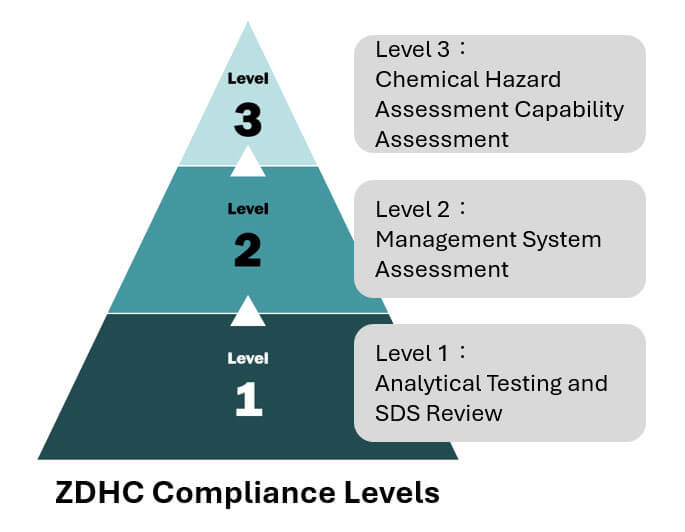
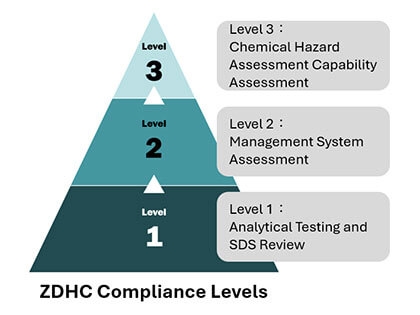
ZDHC Level Schematic
What the Three MRSL Conformance Levels Actually Cover
ZDHC Level Schematic
MRSL conformance is defined by the ZDHC MRSL Conformance Guidance, currently at Version 2.1. The three levels are cumulative: each builds on the requirements of the level below it.
| Level | What is verified | How it is assessed | Gateway requirement |
| Level 1 | Chemical formulation does not contain ZDHC-restricted substances above MRSL thresholds | SDS review + analytical testing (screening and/or full MRSL test panel) | Product listed on Gateway Chemical Module with conformance certificate |
| Level 2 | Level 1 requirements + chemical management system in place at the supplier facility | Level 1 evidence + onsite assessment of EHS management, raw material supplier management, and occupational health and safety practices | Same as Level 1, with onsite assessment records |
| Level 3 | Level 1 + Level 2 requirements + demonstrated chemical hazard assessment capability across the full input-to-output chain | Level 2 evidence + active demonstration of GHS hazard assessment competency (domestic and international), not self-declaration | Same as Level 2, with hazard assessment documentation |
As of the Conformance Guidance v2.0 update in November 2022, Level 3 chemical hazard assessment capability must be actively demonstrated, not simply declared. For procurement teams qualifying chemical suppliers, Level 3 provides the highest degree of confidence that a supplier's chemical management is verified through testing, onsite audit, and hazard assessment capability in combination.
How to Verify a Chemical Supplier's MRSL Status on the ZDHC Gateway
The ZDHC Gateway Chemical Module is the central platform for chemical product information within the ZDHC ecosystem. Chemical formulators list their products on the Gateway, and conformance certificates are linked to individual product entries.
To check a supplier's status:
- Log into your ZDHC Gateway account at zdhc-gateway.com.
- Open the Chemical Module and search by company name or product name.
- Locate the product entry and confirm the conformance level and certification scope.
- Check the associated COA or conformance report for the certificate issue date. Conformance records are time-limited and require periodic renewal, so a current date matters more than the conformance level label alone.
If a supplier is not listed on the Gateway, that absence is itself a data point. Gateway listing is a basic requirement for demonstrating MRSL conformance, and suppliers who are not listed cannot provide verifiable conformance status for brand audit purposes.
Why ZDHC Conformance Is Relevant for Zinc Oxide in Rubber and Foam
Zinc oxide is a standard processing chemical in rubber vulcanization and foam formulation, including the outsole and midsole materials used in footwear. The ZDHC MRSL applies to chemical formulations used in the processing of rubber, foam, adhesives, and trims within the textile, apparel, and footwear value chain, which means zinc oxide supplied into these applications falls within the scope of MRSL conformance requirements.
For zinc oxide specifically, MRSL conformance testing covers impurity substances that may be present in the formulation at levels above the MRSL thresholds. The supplier's Gateway listing should include the relevant analytical test results and the scope of MRSL applicability confirmed for that product.
What ZDHC Level 3 Means for a Chemical Raw Material Supplier
Achieving Level 3 conformance as a raw material supplier, rather than as a chemical formulator working with complex multi-ingredient mixtures, involves demonstrating chemical hazard assessment capability across the full input-to-output chain. This includes evaluating the substances used in the supplier's own production process, not only the composition of the final product.
For footwear and apparel manufacturers, sourcing from a Level 3 conformant zinc oxide or zinc carbonate supplier means the chemical management verification extends beyond the product specification into the supplier's production environment and raw material sourcing practices. That is the level of supply chain traceability that brand sustainability audits increasingly expect to see documented.
Practical Implications for Supplier Qualification
When qualifying a chemical supplier against ZDHC requirements, the checklist covers several areas beyond the conformance level itself:
- Gateway listing: Confirm the specific product is listed on the ZDHC Gateway Chemical Module and that the conformance certificate is current, not expired.
- Scope of applicability: MRSL applicability is defined by material category (textiles, leather, rubber/foam, adhesives, or trims). Verify that the listed scope covers your specific application before accepting the certificate as valid for your audit documentation.
- Renewal status: MRSL conformance certificates are not indefinite. Confirm the renewal cycle and whether the supplier has an active process for maintaining continuous conformance between certification periods.
- PID availability: Some brands require suppliers to produce the ZDHC Product Identification (PID) number for chemical inputs used in their facilities. Confirm whether your supplier can provide this before an audit requires it.
Verify Pan-Continental Chemical's ZDHC Conformance on the Gateway
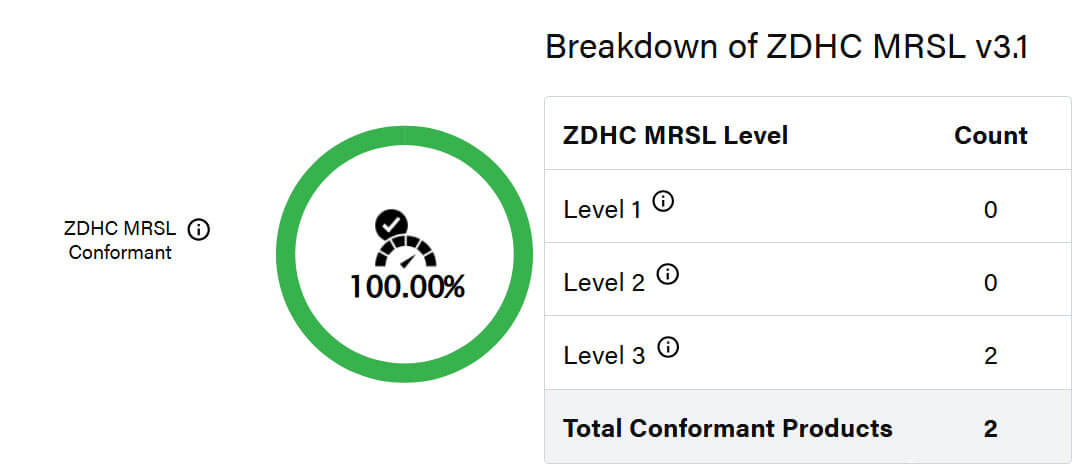
ZDHC Level Breakdown for Pan-Continental Chemical
Pan-Continental Chemical Co., Ltd. achieved ZDHC MRSL Level 3 conformance in 2024 for zinc oxide and zinc carbonate products, supplied to footwear manufacturers for use in rubber and foam formulations.
To review conformance certificates, applicability scope, and associated documentation, search for Pan-Continental Chemical on the ZDHC Gateway Chemical Module using Formulator code A480OS93. Conformance records are maintained and updated in accordance with ZDHC requirements.
If you need a ZDHC Product ID (PID) for your audit file, or have questions about conformance scope for your specific application, contact us at pcc@pccchem.com.tw

