



Inorganic Chemical Analysis Methods: From Purity and Particle Size to Crystal Structure
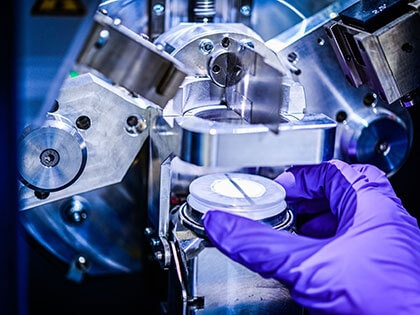
The quality of an inorganic chemical is determined by more than its chemical assay. Depending on the material and its application, manufacturers and users may also need to evaluate trace elements, particle size distribution, specific surface area, crystal structure, morphology, density, or color.
Different analytical methods answer different questions. Titration may be suitable for determining the concentration of a major component, ICP-OES for trace elemental analysis, laser diffraction for particle size distribution, and X-ray diffraction (XRD) for crystalline phase identification.
Understanding what each method measures, and what can influence the result, is therefore essential when establishing specifications or comparing analytical data between suppliers and laboratories.
This article introduces the main analytical methods used for inorganic chemicals and explains how they are applied to different quality characteristics.
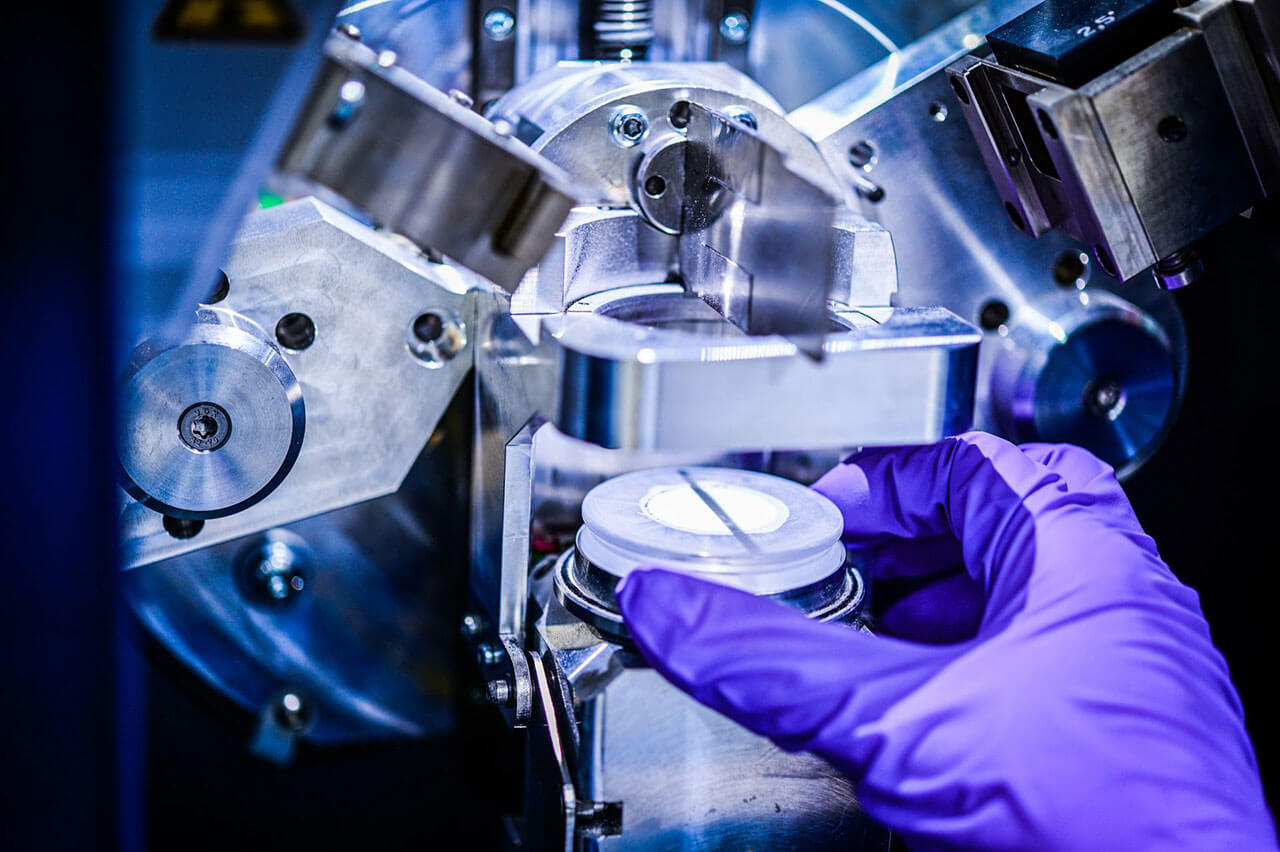
Sample Placed into Analysis Equipment
Qualitative vs. Quantitative Analysis: What Is the Difference?
Chemical analysis is commonly divided into qualitative and quantitative analysis.
Qualitative analysis focuses on identifying what is present in a sample, while quantitative analysis determines how much is present or measures a specific property.
| Analysis Type | Main Question | Typical Result | Example |
| Qualitative analysis | What is present? | Identity, elemental information, or phase information | XRD helps identify crystalline phases in an unknown powder. |
| Quantitative analysis | How much is present, or what is the measured value? | Numerical data with a unit | ICP-OES determines elemental concentration, while laser diffraction measures particle size distribution. |
The distinction is useful, but not absolute. Some techniques can provide both qualitative and quantitative information when suitable methods, calibration, and data analysis are applied.
In practice, the more important question is not whether an instrument is "qualitative" or "quantitative," but whether it can measure the material characteristic that needs to be controlled.
Matching the Analytical Method to the Quality Question
The following table provides a practical overview of common analytical methods and the information they provide.
| Quality Question | Common Analytical Method | Typical Information Obtained |
| What is the assay or concentration of a major component? | Automatic potentiometric titration | Concentration or assay |
| What trace or minor metallic elements are present? | ICP-OES | Multi-element concentration |
| What is the concentration of selected elements? | AAS | Targeted elemental concentration |
| Can a target substance be measured through optical absorption? | UV-Vis spectrophotometry | Concentration based on absorbance |
| What proportion of a coarse powder falls within different size ranges? | Sieve analysis | Percentage retained or passing |
| What is the particle size distribution? | Laser diffraction particle size analysis | Parameters such as D10, D50, and D90 |
| What do the particles look like? | SEM | Particle morphology and surface characteristics |
| Which elements are present in selected areas? | SEM-EDS | Elemental composition and distribution |
| How densely does the powder pack? | Bulk and tapped density testing | Mass per unit volume |
| What is the specific surface area? | Gas adsorption / BET analysis | Specific surface area |
| Which crystalline phases are present? | X-ray diffraction (XRD) | Phase and structural information |
| How consistent is the material color? | Spectrophotometer / colorimeter | Numerical color and color-difference data |
These methods are often complementary. A complete material evaluation may require chemical, physical, and structural analysis rather than relying on a single measurement.
How Are Purity and Concentration Measured?
"Purity" can refer to several different analytical questions.
A manufacturer may need to confirm the concentration of the primary component while also controlling trace metals or other unwanted elements. The appropriate analytical technique therefore depends on both the target being measured and its expected concentration.
Automatic Potentiometric Titration
Titration is commonly used to determine the assay or concentration of substances that react according to a defined stoichiometric relationship.
Automatic potentiometric titrators detect the endpoint instrumentally and record the results electronically, helping reduce variation associated with manual endpoint judgment.
Reliable results still depend on factors such as sample preparation, reagent standardization, reaction conditions, and endpoint determination.
ICP-OES
Inductively Coupled Plasma Optical Emission Spectroscopy (ICP-OES) is widely used for multi-element analysis.
After suitable sample preparation, the sample is introduced into a high-temperature plasma. Elements emit light at characteristic wavelengths, allowing their concentrations to be determined.
ICP-OES is particularly useful for monitoring trace and minor metallic elements in inorganic chemical quality control.
Its analytical performance depends on the element, wavelength, sample matrix, dilution, calibration, sample preparation, and potential spectral interference. For this reason, one universal detection range cannot be applied to all ICP-OES analyses.
Atomic Absorption Spectroscopy
Atomic Absorption Spectroscopy (AAS) is another established technique for elemental analysis.
While ICP-OES is well suited to multi-element analysis, AAS is commonly used when selected elements need to be measured individually or in smaller groups.
The appropriate technique depends on the elements being tested, required sensitivity, sample matrix, throughput, and analytical method.
UV-Vis Spectrophotometry
UV-Vis spectrophotometry determines concentration by measuring how strongly a sample absorbs ultraviolet or visible light at selected wavelengths.
It can be used when the target substance has suitable absorption characteristics, either directly or after an appropriate analytical reaction.
The practical measurement range depends on the substance, analytical method, sample matrix, optical path length, and instrument conditions.
How Are Particle Size and Morphology Evaluated?
Particle characteristics can affect powder handling, mixing, dispersion, reaction behavior, and downstream processing.
Because different techniques evaluate particles in different ways, results obtained by sieving, laser diffraction, and microscopy should not automatically be treated as interchangeable.
Sieve Analysis
Sieve analysis separates particles according to whether they pass through or remain on sieves with defined openings.
It is a simple and useful method for relatively coarse powders and for checking basic size specifications. Results are normally reported as the percentage retained or passing at each sieve size.
For very fine, irregular, cohesive, or easily agglomerated powders, other methods may provide more detailed information.
Laser Diffraction Particle Size Analysis
Laser diffraction is widely used to measure particle size distribution quickly.
Particles dispersed in air or liquid scatter laser light at different angles. The scattering pattern is then interpreted using an optical model to calculate the size distribution, often reported as D10, D50, and D90.
Reliable comparison requires consistent sample preparation and measurement conditions because dispersion, agglomeration, ultrasonic treatment, optical parameters, and other settings can influence the result.
Scanning Electron Microscopy and EDS
Scanning Electron Microscopy (SEM) provides high-resolution images for observing particle shape, surface characteristics, and morphology.
When combined with Energy-Dispersive X-ray Spectroscopy (EDS), elemental information can also be obtained from selected areas of the sample.
SEM and EDS therefore provide information that complements bulk particle size analysis. SEM shows what particles look like, while EDS indicates which elements are present in the areas being examined.
However, elemental information from EDS should not be treated as equivalent to identifying a specific chemical compound or crystalline phase. Structural techniques such as XRD may be required for that purpose.
What Other Physical and Structural Properties Can Be Measured?
Chemical composition and particle size do not fully describe the behavior of an inorganic powder. Other physical and structural characteristics may also affect how a material performs.
Bulk Density and Tapped Density
Bulk density is calculated from the mass of a powder and the volume it occupies before controlled tapping.
Tapped density is measured after the powder has undergone a defined tapping procedure.
These values provide information about powder packing behavior and may be relevant to packaging, material handling, storage, and downstream processing.
Specific Surface Area and BET Analysis
Gas adsorption using the BET method is commonly used to determine the specific surface area of a powder.
Specific surface area can be important when material performance depends on surface-related behavior, such as adsorption, reaction, dispersion, or interaction with other substances.
Depending on the analytical method and instrument, gas adsorption measurements may also provide information related to pore volume or pore size.
X-Ray Diffraction
X-ray diffraction (XRD) is used to characterize crystalline materials.
Each crystalline phase produces a characteristic diffraction pattern. By comparing this pattern with reference data, XRD can help identify crystalline phases and evaluate structural differences between samples.
With appropriate analytical methods, XRD may also be used for quantitative phase analysis or crystallite-size evaluation.
This is particularly useful when materials contain similar elements but differ in crystalline form, something elemental analysis alone may not reveal.
Spectrophotometer and Colorimeter
Color can be an important quality parameter for powders and coatings.
Spectrophotometers and colorimeters convert visual differences into numerical data, allowing samples to be compared with defined standards rather than relying only on subjective visual inspection.
This supports more consistent color control between production batches.
FAQ About Inorganic Chemical Analysis
Q1: Why Can Zinc Assay Results Differ Even When Both Laboratories Use EDTA Titration?
A: When testing zinc-containing materials such as zinc oxide, different indicators, endpoint determination methods, and sample preparation procedures can affect the assay result.
For multi-component samples, interfering substances may also need to be controlled before titration. When comparing results, it is therefore important to confirm that both laboratories are using equivalent analytical procedures, not simply the same titrant.
Q2: Why Can the Same Sample Produce Different Results on Different ICP-OES Instruments?
A: Differences may result from analytical wavelength selection, spectral interference, background correction, sample preparation, calibration, and matrix effects.
High concentrations of other elements or dissolved salts can also influence the measurement. A meaningful comparison should therefore consider the entire analytical method rather than the instrument model alone.
Q3: Why Can the Same Powder Produce Different Particle Size Results?
A: Differences can arise from both sampling and dispersion.
If the powder is not homogeneous, different test portions may produce different distributions. For wet laser diffraction, the dispersion medium, dispersant, ultrasonic treatment, and degree of agglomeration can also affect the measured result.
Consistent sampling and dispersion procedures are therefore essential when comparing particle size data.
Q4: How Should an Unknown Inorganic Powder Be Analyzed?
A: Unknown powders are usually characterized using complementary techniques.
XRD can help identify crystalline phases, SEM can reveal particle morphology, and EDS can provide elemental information. Once the likely material has been identified, appropriate quantitative and physical-property tests can then be selected.
Q5: How Does Analytical Testing Support Consistent Inorganic Chemical Quality?
A: Analytical testing is part of a broader quality assurance process that helps confirm whether raw materials, in-process materials, and finished products meet defined specifications.
At Pan-Continental Chemical, our R&D and analytical capabilities include ICP, laser diffraction particle size analysis, BET surface area analysis, XRD, and other instruments to support product development and quality control. Together with controlled manufacturing procedures and documented specifications, these measurements help maintain consistent product quality from batch to batch.
Reliable Analysis Depends on More Than the Instrument
Accurate inorganic chemical characterization requires the analytical method to match the property being evaluated.
The instrument is only one part of that process. Sampling, sample preparation, calibration, measurement conditions, and data interpretation can all influence the final result.
For manufacturers and users of inorganic chemicals, consistent quality therefore depends on applying appropriate analytical methods under well-controlled conditions and using the resulting data to support clearly defined product specifications.

